
Bedside Lamp Buying Guide: Size, Shade, and Switch Types Explained
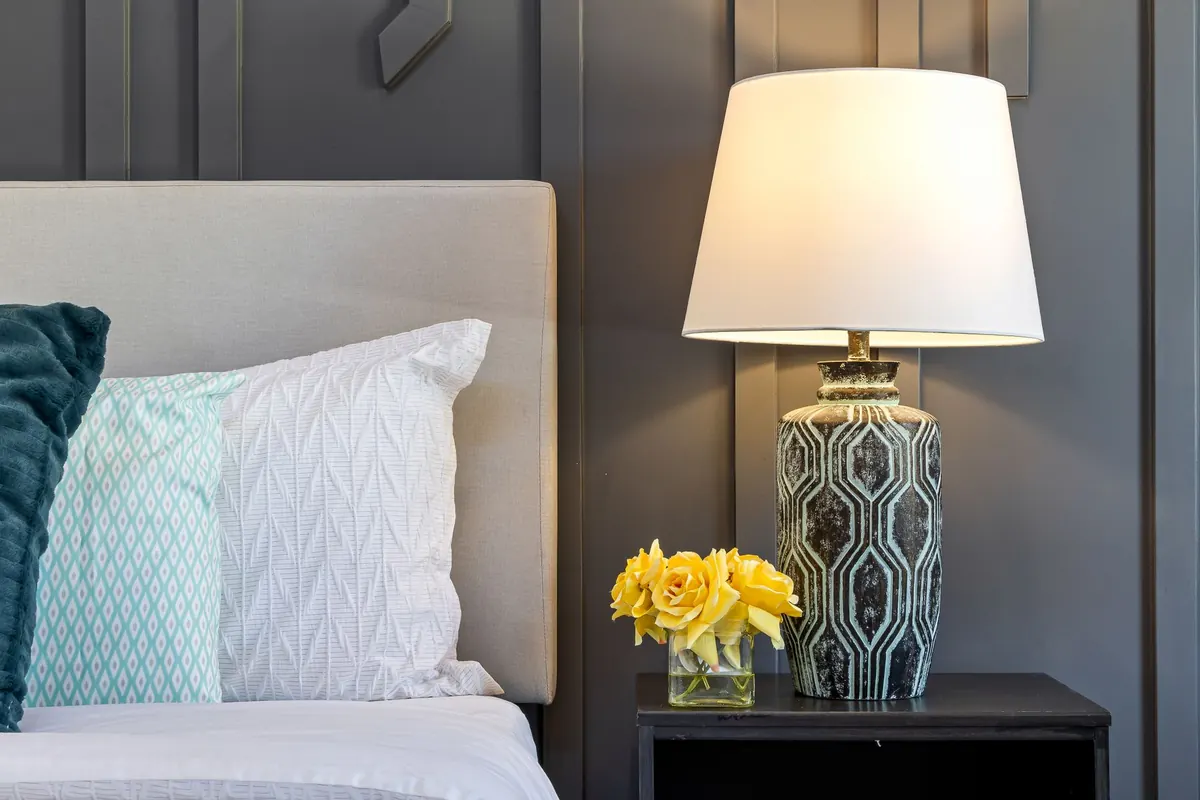
A bedside lamp is the hardest-working light in the house, and the one you judge most harshly. You reach for it half-asleep, read under it for an hour, and stare at its shape from your pillow every night. Get the size wrong and it looms over the nightstand or vanishes behind the headboard. Get the shade wrong and the page glares or the corner goes flat and grey. Get the switch wrong and you will spend every evening patting around the cord like you are defusing something. The good news is that bedside lighting is not complicated once you know what to measure — and what to ignore.
Start With the Nightstand, Not the Lamp
Most people fall in love with a lamp in a shop and then try to make it fit the room. Work the other way around. Measure your nightstand first: its height from the floor, and the clear width and depth of its top. Those two numbers eliminate half the catalogue before you spend a minute browsing.
The number that matters most is the height of the shade's bottom edge relative to your eyes. Sit up in bed, back against the headboard, in the position you actually read in. Have someone measure from the mattress up to your eye level, then compare that to your nightstand height. You want the bottom edge of the shade to land somewhere between your shoulder and your eye line. Higher than that and you are looking straight at the bulb; lower and the light spills across the page at a bad angle, throwing a shadow from your own hands.
Bedside table lamps generally run somewhere between about 18 and 27 inches tall including the shade, which is a wide range for a reason — nightstands vary enormously. A low, modern nightstand at 20 inches needs a taller lamp to reach the right height. A tall chest of drawers pressed into service as a bedside table needs something shorter and wider so it does not crowd the headboard.
Leave room to breathe
Footprint matters as much as height. On a narrow nightstand — many are only 14 to 16 inches wide — a lamp base over about 8 inches in diameter leaves no space for a glass of water, a book, or your phone. You want at least two inches of clear surface on every side of the base. If your nightstand is genuinely tiny, stop hunting for a table lamp and look at wall-mounted reading lights or clamp lamps instead. They free the surface entirely and put light exactly where you need it.
Shade Size, Shape, and How to Measure
A shade that is too small makes a sturdy lamp look like a mushroom. Too large and it looks like a hat. Two proportions do most of the work:
- Width: the bottom diameter of the shade should be roughly equal to, or a little wider than, the widest part of the lamp base. A shade narrower than the base almost always looks wrong.
- Height: a shade about two-thirds the height of the lamp body (base to socket) reads as balanced. Slightly taller is fine on a slender base; shorter suits a squat, heavy one.
Shape changes the light as much as the look. A tapered or empire shade throws light up toward the ceiling and down onto the page, which makes it a natural fit for reading. A drum shade spreads light more evenly sideways and gives a softer, more ambient wash. Bell shades are forgiving and traditional; rectangular shades suit a desk-style base and a low, wide nightstand.
If you are replacing only the shade, check the fitting before you buy. Most lamps use a spider fitting, where the shade sits on a harp and is held by a finial. Some use an uno fitting, where the shade clips directly onto the socket. Measure the existing shade's top and bottom diameter and its vertical height, and bring those numbers with you.
Shade Materials and What They Do to Light
The shade is a filter. It decides whether the light in the room is warm or clinical, focused or soft, and whether your partner gets a face full of glare while you finish a chapter.
- Linen and cotton: the reliable default. They scatter light gently, hide fingerprints, and make almost any bulb look kinder. A white or off-white lining gives the cleanest light; a brass or gold lining warms it further.
- Paper: soft, light, and inexpensive, but delicate and easily dented. Fine in a guest room, risky in a house with small children.
- Metal: opaque, so it directs light down in a focused pool instead of spreading it. Excellent for reading, less good for relaxing. Avoid a highly polished interior if you sit close to it.
- Glass or opal acrylic: bright, easy to dust, and good in a room where the lamp stays on all evening. Less atmospheric than fabric.
- Rattan and woven fibres: beautiful texture and lovely shadows on the wall, but they let a lot of light escape sideways, which can be distracting on a page.
- Dark or opaque shades: the practical choice when one of you reads and the other sleeps. They keep light low and contained.
Whatever you choose, hold the shade up to a lamp before buying if you can. A fabric that looks creamy in the shop can turn pink under a warm bulb and green under a cool one.
Switch Types and Where Your Hand Goes
Here is the test that separates a good bedside lamp from an annoying one: can you turn it on and off without opening your eyes? The switch needs to sit where your hand naturally lands — on the nightstand surface, or just beneath the shade — not three feet down a cord behind the table.
- Turn knob on the socket: simple, tactile, and easy to find by feel. Often combined with three-way brightness if you use a three-way bulb.
- Rocker or push button on the socket: quick and positive, but you need to reach up into the light to use it.
- In-line cord switch: only workable if the switch lands on the nightstand top rather than the floor. Check the distance from the base to the switch before you buy.
- Pull chain: easy to find in the dark and satisfying to use, though it dangles where a curious cat can reach it.
- Touch-sensitive base: elegant, but check that your chosen bulb is compatible — some touch lamps are fussy about dimmable LEDs.
- Rotary or slider dimmer: the most useful option for a bedroom, because it lets you go from reading brightness down to a low glow without getting out of bed.
- Smart plug or app control: handy for scheduling and voice control, but a poor substitute for a physical switch you can slap in the dark. Keep both.
If you share a bed, a dimmer is worth more than any other feature. So is a lamp with a second, smaller light in the base, or a pair of lamps with separate switches, so one of you can read while the other settles.
Reading Versus Relaxing: Matching the Lamp to the Job
Reading light wants to come from the side and slightly behind your shoulder, aimed at the page, at a brightness that does not force your eyes to work. A warm white bulb — somewhere in the 2700 to 3000 K range — is comfortable for long stretches, and an adjustable arm or a tiltable metal shade lets you aim it precisely. Around 800 lumens is a reasonable starting point for a reading lamp; go brighter only if you like a lot of light.
Relaxing light wants the opposite: low, warm, indirect, and spread around the room rather than pointed at anything. If you want one lamp to do both jobs, buy a dimmable one and accept the compromise. If you have the space and the budget, a focused reading lamp plus a softer ambient source — a small table lamp on the opposite side, or a wall sconce — gives you both without changing a bulb.
A Short Checklist Before You Buy
- Measure your nightstand's height, width, and depth, and note how much clear surface you need to keep.
- Sit in bed and measure from the mattress to your eye level. Compare it to the nightstand height.
- Check that the shade's bottom edge will fall between your shoulder and your eye line.
- Confirm the shade is at least as wide as the widest part of the base.
- Decide whether the switch will be reachable from lying down — and whether you want dimming.
- Check the bulb type and fitting the lamp takes, and whether it is compatible with a dimmer.
- Choose a shade material that suits the job: fabric for softness, metal for focus, opaque for keeping light off your partner.
Buy for the position you actually read in, not the one you imagine, and the lamp will disappear into the background where it belongs.
Photo: Curtis Adams / Pexels